
The Unexpected Costs of Warehouse Peak Season (and How to Stop Paying Them)
unexpected costs during peak season in a warehouse

Every warehouse plans for peak. The volume forecast is built, the temp agency is booked, and carrier contracts are signed well before the first holiday order lands. And yet, when the season wraps up in January, the P&L almost always tells the same story: sales were up, but margin didn't follow.
That's because the biggest costs of peak season aren't the ones in the budget. They're buried in overtime premiums, in new hires working at a fraction of full speed, in thousands of wasted steps across the floor, and in mispicks that come back as returns weeks later. None of them look dramatic on their own. Together, they can quietly eat the season's profit.
Here's where the money actually goes.
1. Labor costs more per hour than you think
Labor is already the largest line in most distribution centers, typically 50–70% of total operating costs. Peak season doesn't just add hours; it makes every one of those hours more expensive.
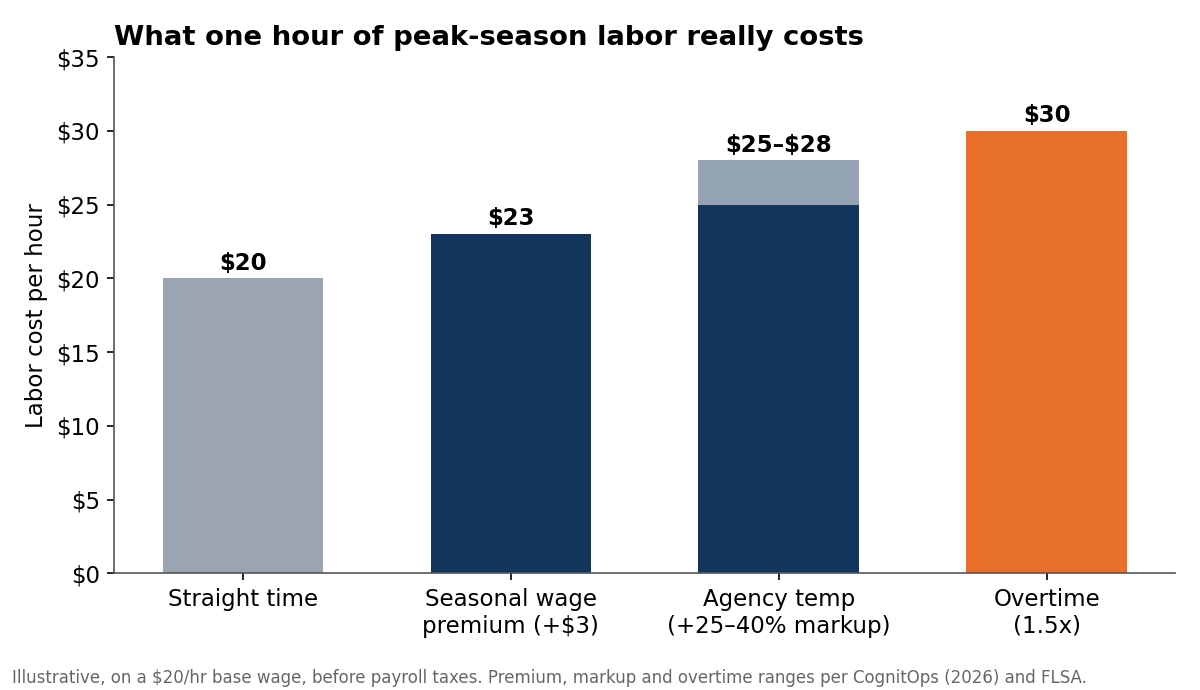
Several premiums stack at once. Seasonal wage bumps commonly run $2–4 per hour above base in competitive markets. Agency-sourced temps carry a 25–40% markup on every hour worked. And once your core team crosses 40 hours, federal law requires at least 1.5x their regular rate, calculated week by week, so a slow week in October can't offset a brutal one in December.
Across the affected workforce, overtime alone can push effective hourly rates up 15–25% during a typical peak. When overtime, temp premiums, training, turnover and error costs are all counted, the real cost of manual warehouse labor often lands at 2–3x what the base wage suggests.
2. New hires cost full price for partial output
The staffing plan says you need 40 people, so you hire 40 people. But seasonal hires don't arrive at full speed.
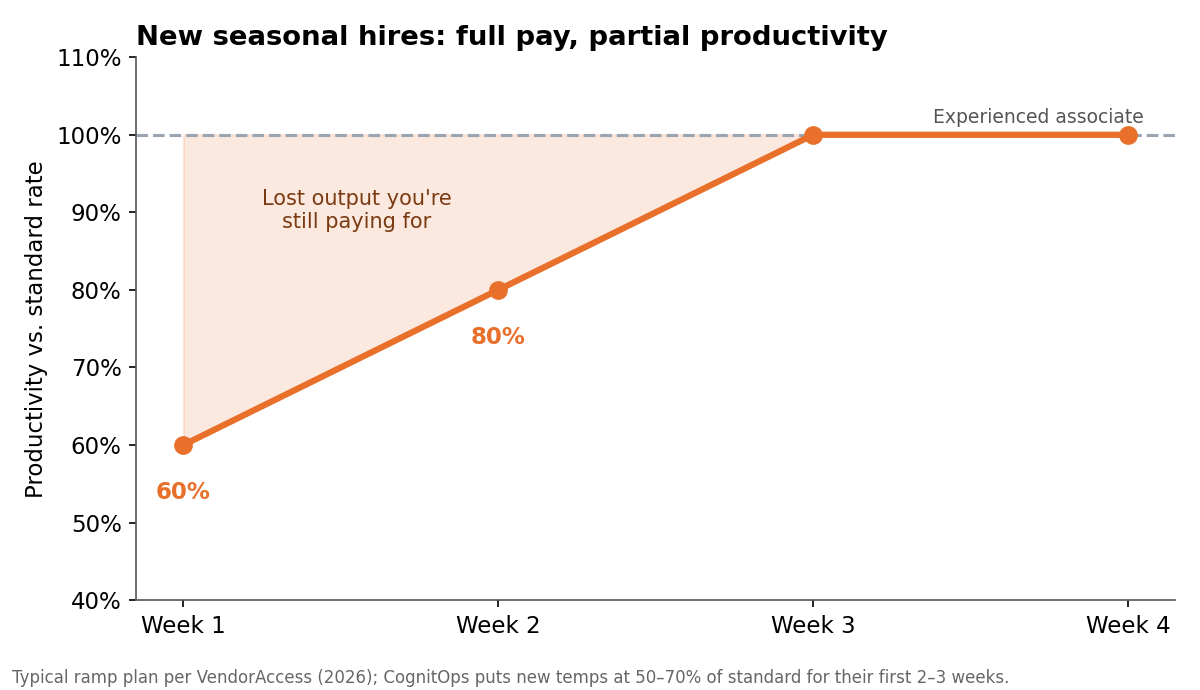
New temporary associates typically work at 50–70% of standard productivity for their first two to three weeks. A common ramp plan looks like 60% in week one, 80% in week two, and full speed by week three, and that's when onboarding goes well. In practice, that means a cohort of 40 brand-new hires can leave you effectively 8–12 people short during the exact weeks volume is climbing.
The drag doesn't stop with the new hires, either. Your best associates get pulled off the floor to train, supervise and fix mistakes, which cuts into the throughput of the very people you're counting on most.
3. Half the shift is spent walking
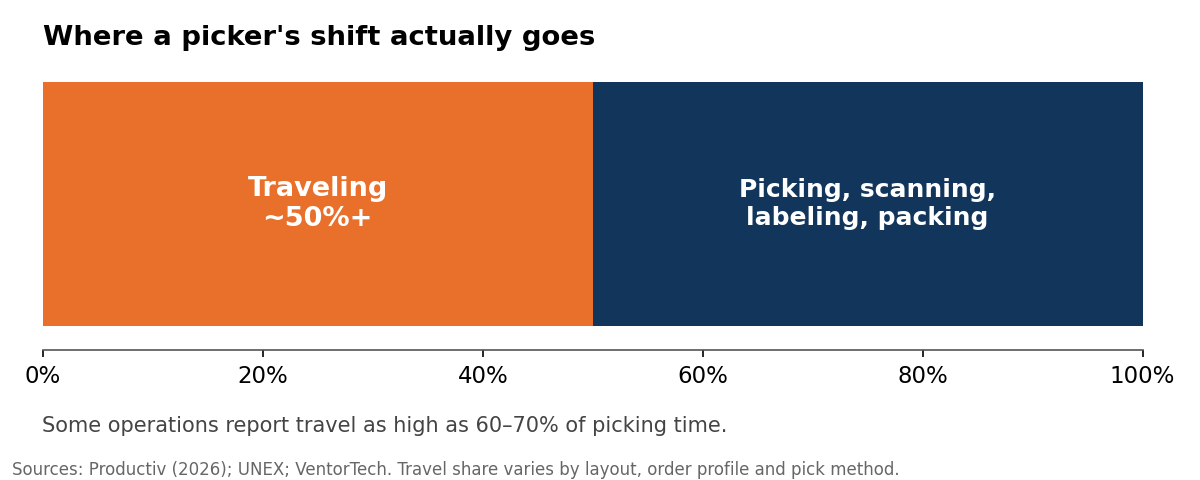
Here's the cost almost nobody budgets for: movement. Studies consistently show that travel accounts for 50% or more of total picking time in most warehouses, and some operations report pickers walking 60–70% of the day.
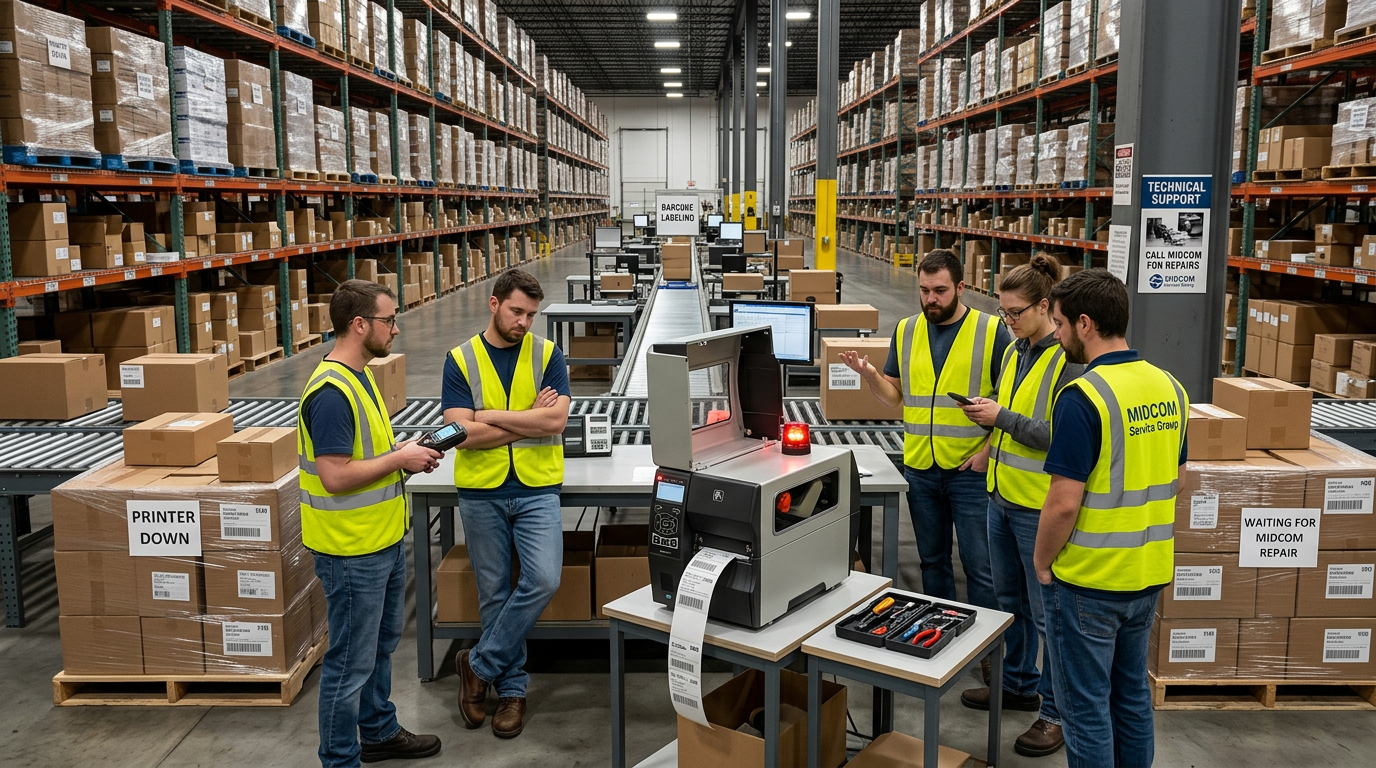
Every trip back to a fixed terminal to check an order, every walk to a shared printer to grab a label, every detour to swap a dead scanner battery adds up. In normal months, that inefficiency is absorbed. During peak, when every labor hour costs a premium and a new hire is still learning the layout, those wasted steps become one of the most expensive activities on the floor.
4. Mispicks multiply with volume and inexperience
Speed pressure, fatigue and inexperienced staff all push error rates up at the same moment order volume spikes. And every mistake is expensive: industry estimates for a single mispick cluster between $30 and $75, with broader estimates running from $50 up to $300 depending on the product and how the error is resolved.
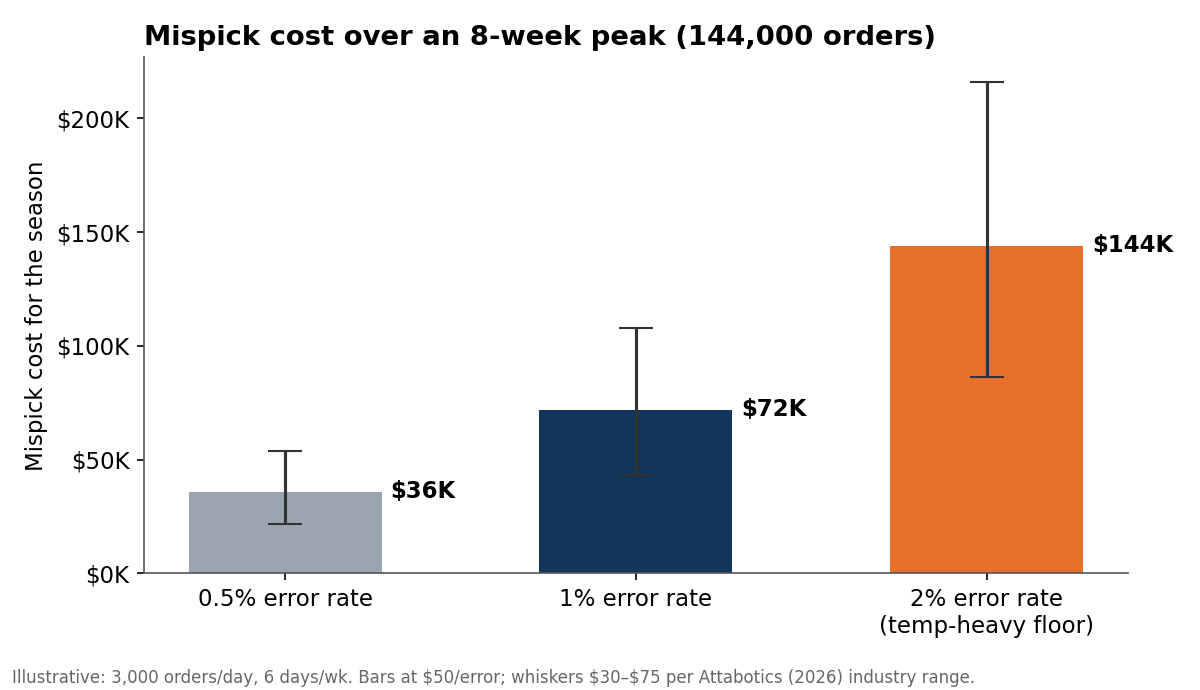
Consider an operation shipping 3,000 orders a day, six days a week, through an eight-week peak. At a 1% error rate and $50 per incident, that's roughly $72,000 in mispick costs for the season. If a temp-heavy floor lets that rate slip to 2%, the bill doubles to about $144,000, before counting the customers who don't come back. Each error means paying to pick, pack and ship the order twice, plus return shipping, restocking and customer-service time.
5. Carrier surcharges raise the stakes on every package
Outbound costs climb too. For 2026, carrier peak surcharges started in late September and step up again in late October. FedEx's peak-period residential surcharge rose to $0.80 per package, up from $0.65 last year, and UPS Additional Handling demand surcharges will reach $11.90 per package from November 22 through December 26.
You can't control carrier pricing. But when every package already carries a surcharge, a mispicked order that has to be shipped twice, or a shipment that misses its truck and has to be expedited, costs even more than it did in July.
The common thread: wasted motion
Look closely at these costs and a pattern shows up. Overtime is driven by throughput that can't keep pace. New-hire drag is worst when people have to learn where every terminal and printer is. Travel time is pure wasted motion. And many mispicks happen when verification is separated from the pick, when a worker has to remember an item, walk to a station, then scan and label it away from the shelf.
Adding more people at peak premiums doesn't fix any of that. Bringing the work to the worker does.
The fix: mobile workstations from MIDCOM Service Group
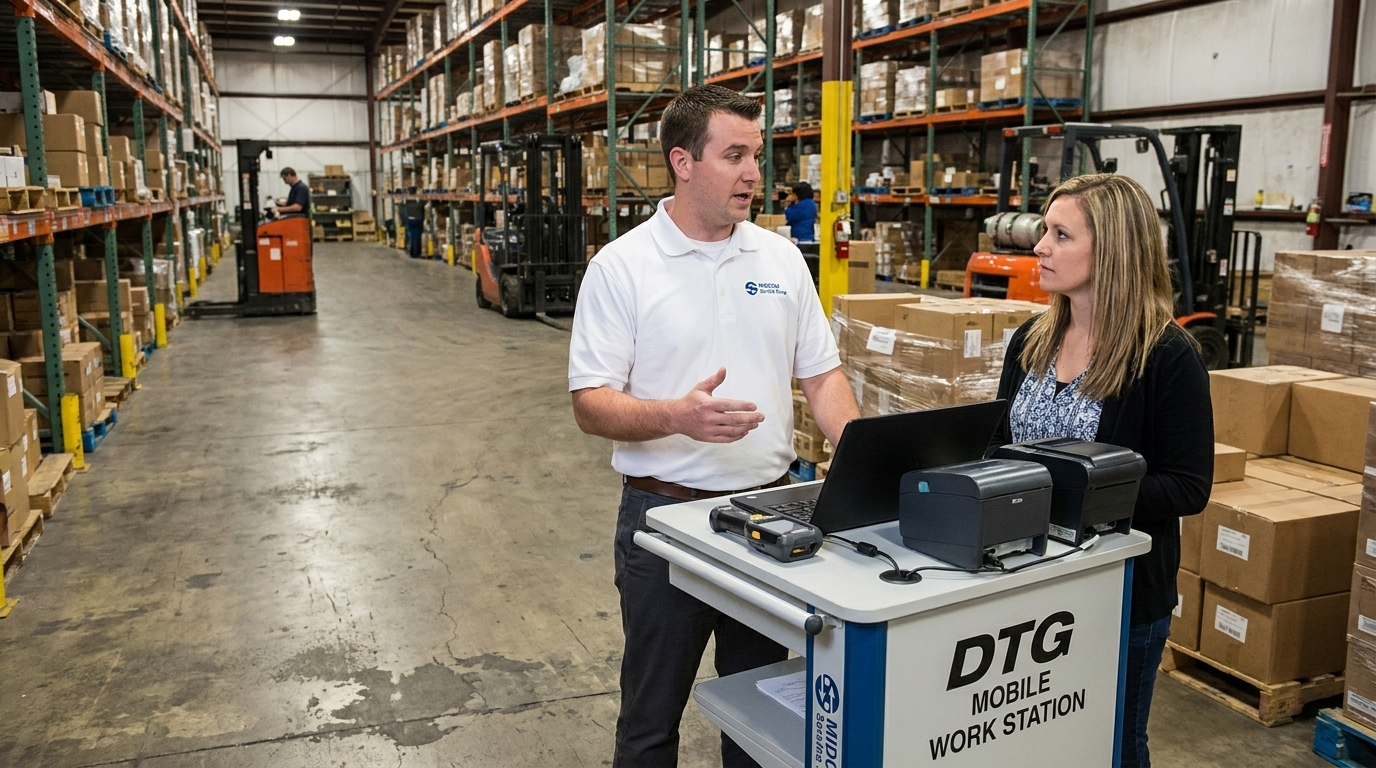
Mobile workstations, also called powered carts or computer carts, put the laptop, barcode scanner and label printer right where the work happens. Instead of walking back to a fixed station after every task, associates scan, verify, print and apply labels at the point of activity. That directly targets each of the peak-season costs above:
- Less travel, more picks per hour. Staying in the workflow instead of returning to a terminal cuts wasted steps, which is where half the shift goes.
- Fewer mispicks. With the scanner and printer on the cart, items are verified at the shelf before they ever reach packing, reducing mis-picks, shipping errors and costly returns.
- More volume from the same team. Reducing wasted motion lets the same workforce handle higher volume without adding headcount, which means less overtime and fewer premium-priced temp hours.
- Faster ramp for seasonal hires. When everything a new associate needs rolls with them, there's less layout to memorize and fewer handoffs to get wrong.
- No dead-battery downtime. Powered carts keep laptops, printers and scanners running for the full shift, so nobody stands idle waiting on a charger or a shared device.
- Safer, less fatiguing work. Height-adjustable designs reduce bending, twisting and carrying, which matters most during long, high-pressure peak shifts.
- Flexible where you need it. Carts can be redeployed to receiving, picking, packing, cycle counting or shipping as peak bottlenecks shift week to week.
MIDCOM offers two proven brands to fit different operations:
Newcastle Systems Mobile Workstations are an entry-level cart solution with an excellent price-to-performance ratio. They're ideal for powering a laptop, barcode printer and scanner for 8+ hours, making them a strong fit for operations that want to put a fully equipped workstation in every aisle without a large capital outlay.
DTG Mobile Workstations offer rechargeable power for up to four devices at once for 8–12+ hours. Their slotted mast system lets shelves and accessories be reconfigured for each user in seconds, ideal for multi-shift peak operations and teams that move carts between tasks.
Peak season is predictable. The hidden costs don't have to be. Every step you remove from the workflow before November is a step you won't pay overtime for in December.
Explore mobile workstation solutions from MIDCOM Service Group → or talk to a specialist at (800) 643-2664.
Sources
- MIDCOM Service Group — Mobile Workstations
- CognitOps — How to Forecast Warehouse Labor for Q4 Peak 2026
- CognitOps — Why Warehouse Labor Cuts Backfire Without Efficiency Gains
- Eclipse Advantage — The Cost of Seasonal Overtime
- NEO Intralogistics — Warehouse Labor Costs: The Real 2026 Numbers
- VendorAccess — How to Hire Warehouse Workers Faster Without Sacrificing Quality
- Future Force Personnel — Seasonal Warehouse Staffing Solutions
- Productiv — How to Improve Warehouse Pick Rate
- UNEX — Cutting Travel Time in Warehouses
- Attabotics — What a Mispick Actually Costs Your Warehouse
- Deposco — Peak Season Shipping Surcharges 2026
- Intelligent Audit — UPS 2026 Holiday Surcharges