
Why Mobile Carts Are Becoming the Backbone of Modern Warehouse Operations
mobile carts and warehouse operations
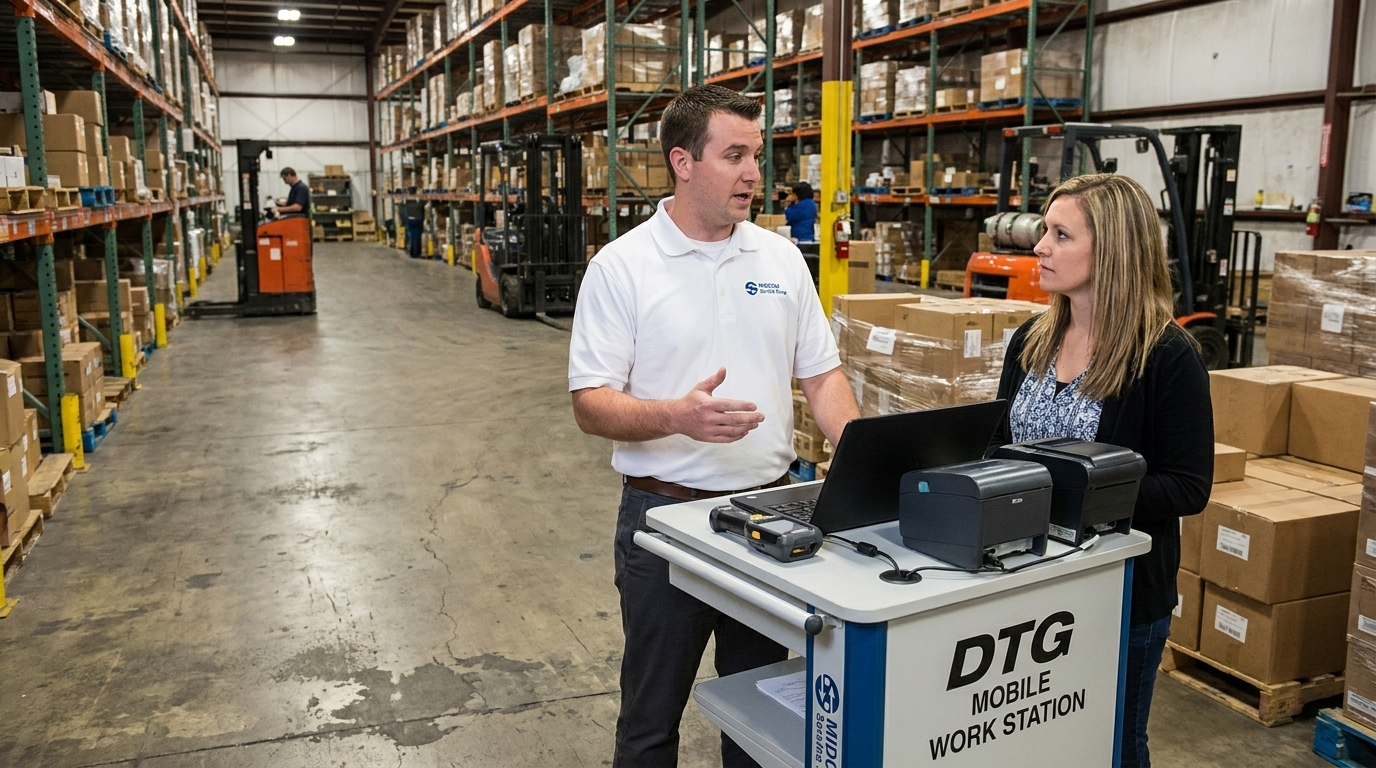
Walk through almost any warehouse today and you'll notice the same bottleneck repeating itself hundreds of times a shift: a worker finishes a scan, then walks — sometimes fifty, a hundred, two hundred feet — back to a fixed workstation to log the data, print a label, or check the WMS. Multiply that walk by every picker, packer, and receiving associate on the floor, and you're looking at thousands of wasted steps and hours of lost productivity every single day.
This is the exact problem mobile workstation carts were built to solve, and it's why more warehouses, distribution centers, and third-party logistics (3PL) operations are rethinking the fixed-desk model entirely. Bringing the computer, scanner, and printer to the point of task — rather than making the worker travel to the technology — has quietly become one of the highest-ROI changes a warehouse can make.
The Hidden Cost of Fixed Workstations
Fixed desks and stationary terminals made sense when warehouses were smaller and inventory moved more slowly. But as order volumes have grown and fulfillment windows have shrunk, that model has started to show its cracks. Every trip a worker makes to a stationary terminal is time they aren't picking, packing, receiving, or counting inventory. It adds up in ways that are easy to underestimate:
- Wasted steps. Warehouse associates routinely walk miles per shift just to reach a terminal, log data, then walk back to where the actual work is happening.
- Worker fatigue. Unnecessary walking compounds physical strain, especially in facilities running multiple shifts or seasonal peak volumes.
- Delayed data entry. When workers batch their scans and updates instead of recording them in real time, the WMS lags behind what's actually happening on the floor — and that lag creates blind spots for supervisors and planners.
- Labeling and picking errors. The farther a worker is from the point of task when they log information, the more likely small errors creep in — the wrong SKU, a mislabeled pallet, a missed pick.
None of these costs show up as a single dramatic failure. They show up as a slow, steady drag on throughput and accuracy — the kind of inefficiency that's easy to overlook until you add it up across a full year of operations.
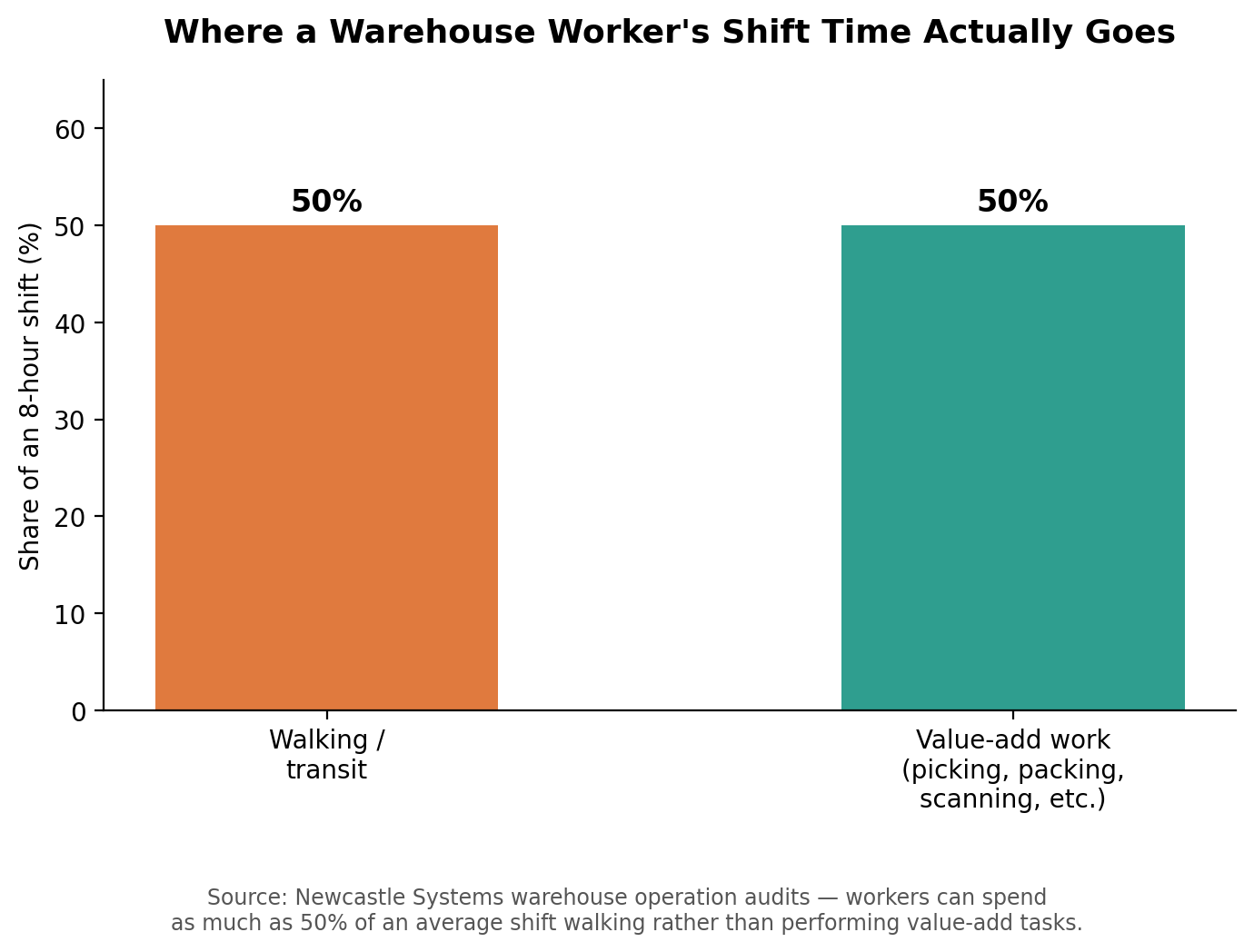
Operation audits across warehouses have found that workers can spend as much as half of an average shift walking rather than doing value-add work — a striking split when you consider that walking itself produces nothing for the business.
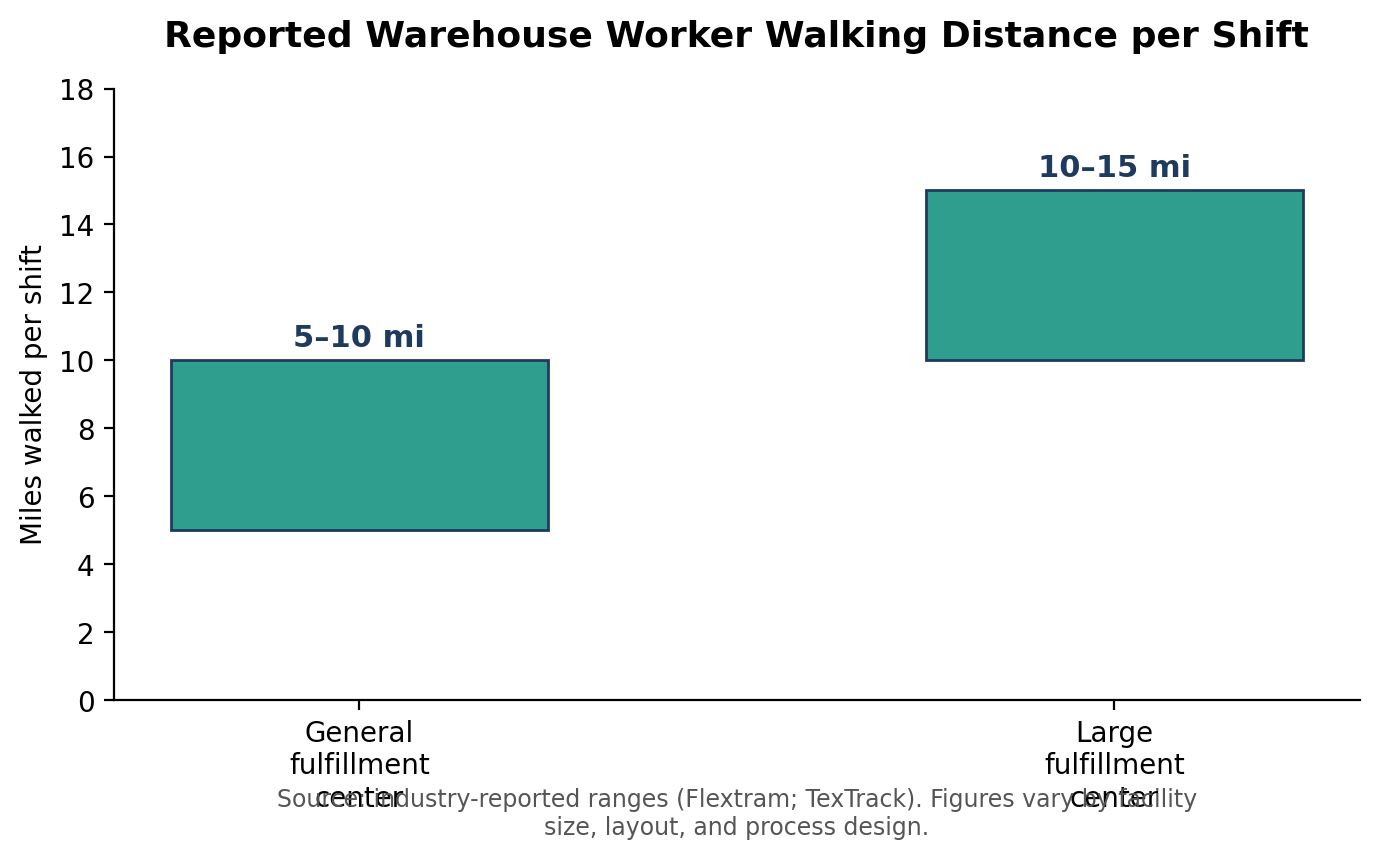
That walking adds up fast. Depending on facility size and layout, warehouse workers commonly cover anywhere from 5 to 15 miles per shift — distance that's largely driven by the trip back and forth between the point of task and a fixed terminal.
What Mobile Carts Actually Change
A mobile workstation cart flips the equation: instead of the worker traveling to the technology, the technology travels with the worker. A well-designed cart brings a laptop or micro-computer, a barcode scanner, and often a thermal label printer directly to wherever the task is happening — the dock door, the pick face, the inventory count zone.
The result is that scanning, labeling, updating the WMS, and recording picks all happen on the spot, in real time, instead of in a delayed batch back at a fixed desk. That single shift — from "walk to the data" to "bring the data with you" — is where most of the productivity gain comes from.
Specifically, mobile carts tend to improve warehouse operations in a few concrete ways:
1. Faster task completion. Eliminating the round trip to a stationary terminal directly shortens the cycle time for receiving, picking, packing, and cycle counts. Even a modest reduction in walking per task translates into meaningful throughput gains when it's repeated hundreds of times a day across a full team.
2. Improved accuracy. Recording data at the point of task — rather than trying to remember details until you reach a terminal — reduces mislabeling, miscounts, and picking errors. Fewer errors mean fewer costly corrections, fewer returns, and less time spent on rework.
3. Real-time visibility. When workers can update the WMS and inventory systems immediately, supervisors get an accurate, live picture of what's happening on the floor instead of a picture that's an hour (or a shift) behind. That visibility matters enormously for staffing decisions, order prioritization, and catching problems before they cascade.
4. Reduced worker fatigue. Cutting unnecessary walking isn't just about speed — it's about the physical toll on your team. Less fatigue over a shift means more sustained productivity and, over time, can support better retention in a labor market where warehouse turnover is a constant challenge.
5. Flexibility across processes. Because the cart itself is mobile, the same unit can support receiving in the morning and inventory counts in the afternoon, without needing to build out multiple fixed stations across the facility.
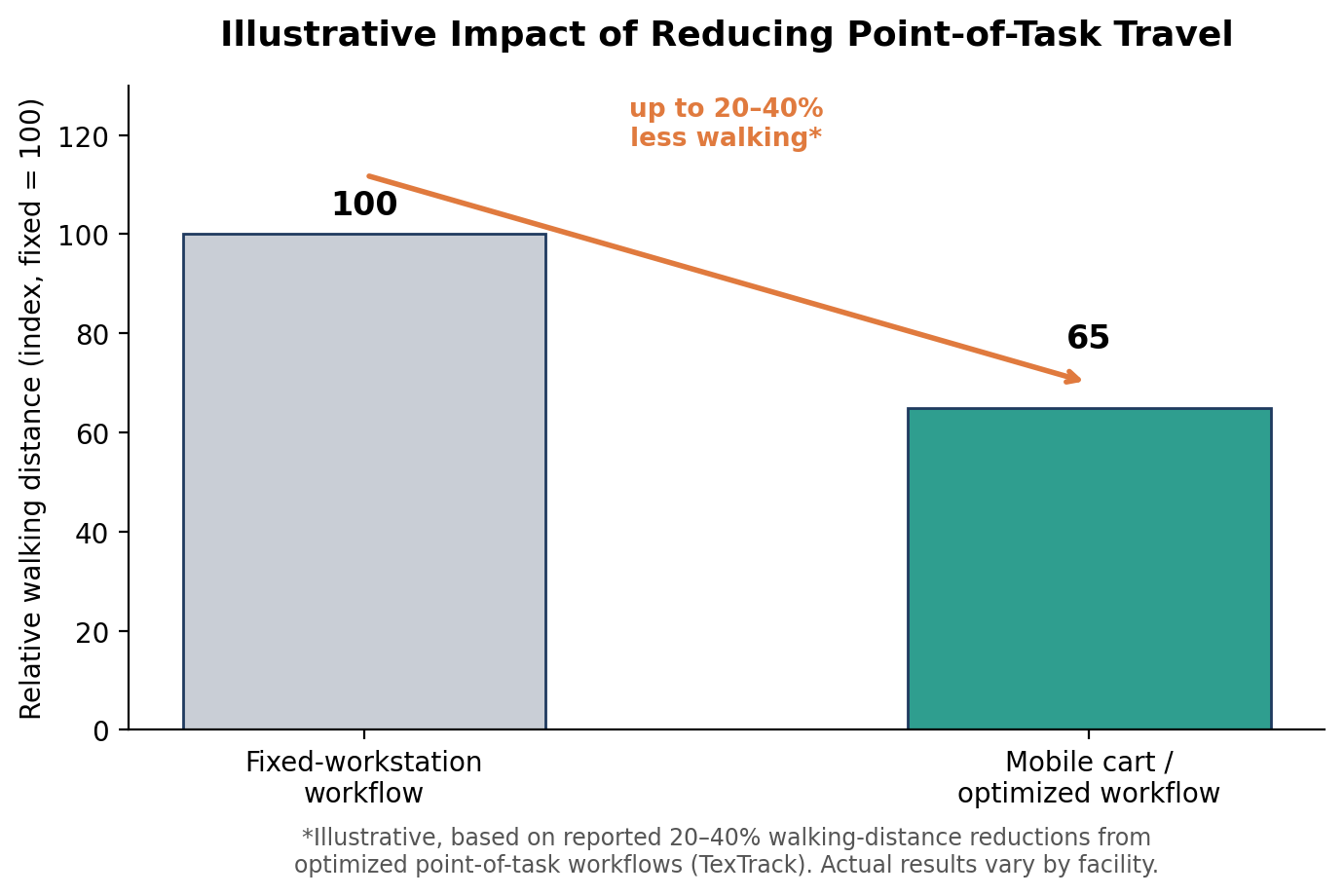
Optimizing how far workers travel to complete a task — whether through smarter pick-path routing, mobile carts, or both — has been shown to cut walking distance by roughly 20–40%. Applied across an entire shift, that reduction is where most of the throughput, accuracy, and fatigue gains come from.
Why the Details of the Cart Matter
Not all mobile carts are created equal, and the difference tends to show up exactly where it matters most: uptime and reliability. A cart that can't hold a charge through a full shift, or that relies on battery chemistry prone to degradation and safety concerns, quickly becomes another point of friction rather than a solution.
This is where purpose-built industrial mobile workstations — like the DTG mobile workstation carts available through MIDCOM Service Group — separate themselves from generic solutions. DTG's carts are built around Lithium Iron Phosphate (LFP) batteries, which are widely regarded as the safest and most stable battery chemistry available for industrial environments, and they're engineered to deliver extended runtime so a cart can genuinely last through a demanding shift rather than needing a mid-shift swap or recharge.
Just as important is what the cart is designed to carry. A workstation configured to support a laptop, a small thermal printer, and a barcode scanner — with an uninterruptible power system keeping everything running smoothly — means workers aren't choosing between mobility and capability. They get the same tools they'd have at a fixed desk, just without the walk to get there.
The Business Case: This Isn't Just an Efficiency Story
It's tempting to think of mobile carts purely as a "nice to have" for worker comfort. But the more compelling case is financial. Every process that moves from a fixed station to the point of task — receiving, order picking, inventory counts — becomes faster and more accurate, and those gains compound across an entire operation.
That's a big part of why vendors in this space, including DTG, back their mobile workstations with strong ROI guarantees: the efficiency gains from eliminating unnecessary walking, speeding up task completion, and reducing errors are typically substantial enough to pay back the investment well within the first year of deployment.
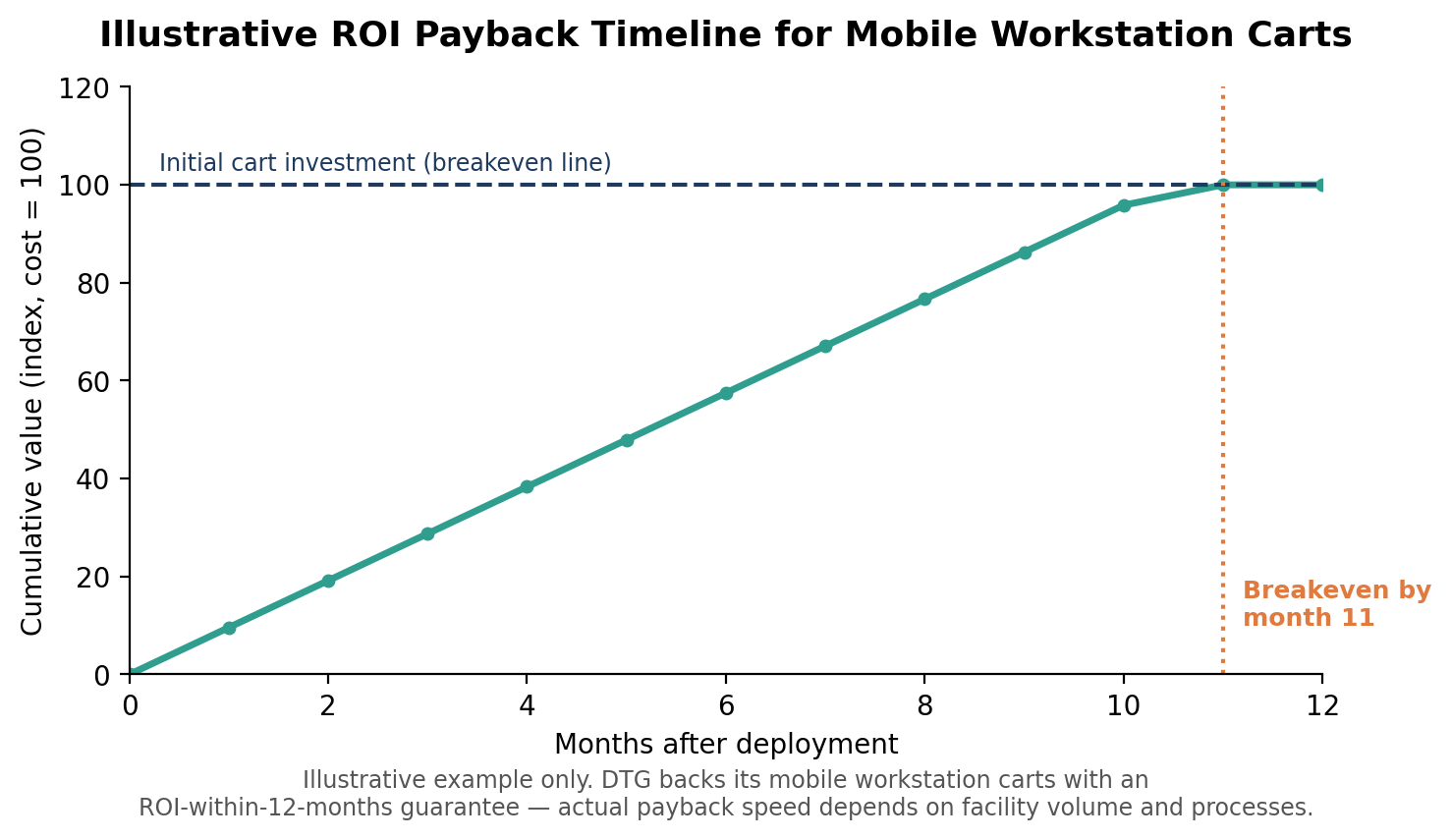
DTG guarantees an ROI within 12 months on its mobile workstation carts, or it will refund the purchase — a level of confidence that reflects just how consistently these efficiency gains show up once carts are deployed on the floor.
For warehouse and operations leaders evaluating where to invest limited capital, that's a meaningful signal. Mobile carts aren't a speculative bet on a future efficiency gain — they're a well-understood category of equipment with a track record of measurable payback.
Who Benefits Most
While almost any warehouse can benefit from mobile workstations, a few environments see especially strong results:
- 3PLs managing variable volumes and multiple clients, where flexibility and speed of onboarding new processes matter enormously.
- High-SKU distribution centers where labeling accuracy and real-time inventory updates are critical to avoiding costly mis-ships.
- Facilities running peak seasonal volume, where every reduction in walking and every gain in throughput has an outsized impact on meeting demand without adding headcount.
- Operations transitioning to real-time WMS integration, where the value of live data only fully materializes if workers can actually record information at the point of task.
Making the Move to Mobile
The shift from fixed workstations to mobile carts doesn't require ripping out existing infrastructure or overhauling your WMS. It's an incremental change that layers directly onto existing processes — receiving, picking, packing, and counting all continue to work the same way, just faster and with fewer steps between the worker and the data.
For warehouse leaders weighing where to focus efficiency investments this year, mobile workstation carts represent one of the more straightforward wins available: a change that workers feel immediately, that supervisors see in their real-time data, and that finance teams can measure in hard ROI numbers.
If you're evaluating mobile workstation solutions for your warehouse or distribution center, take a look at DTG's mobile workstation carts available through MIDCOM Service Group. Built on industrial-grade LFP battery technology and designed to bring your team's laptop, scanner, and printer directly to the point of task, they're a practical next step for any operation looking to close the gap between fixed-desk inefficiency and floor-level productivity.
Learn More About DTG Mobile Carts with MIDCOM →
MIDCOM has been helping companies with warehouse solutions since 1982. Talk to one of our Specialists about smartphone mobile devices, thermal barcode label printers, mobile barcode scanning devices, software or mobile workstations today. Call now (800) 643-2664.